
During the frigid winters in North America, hockey transforms from a simple game into a way of life. Amateur players spend the first half of 5 a.m. practices with frozen toes and warm up just in time to hit the showers and walk through a snowy parking lot to drive home. Imagine walking out of the local rink into sand swirling in a desert wind or the smell of a salty ocean breeze. Players from several of the 72 countries in the tiered divisions of the International Ice Hockey Federation exit ice rinks into vastly different climates every day.
As hockey fever spreads across the globe, national ice hockey teams from countries in the Middle East, Africa, Asia and even the Caribbean aspire to compete with Canada, Sweden and the United States.
Ice hockey transcend politics, religion and cultural differences. For a few minutes on the ice, nothing that creates worldly boundaries matters. The only thing that matters is outworking the opponent to score the next goal and take the win back into the locker room.
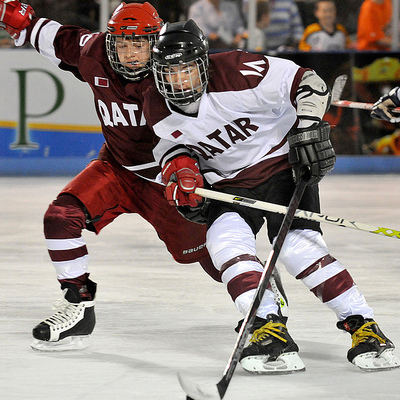
In 2012, the IIHF admitted Qatar, a country in the Middle East sharing borders with Saudi Arabia and Oman. Summer temperatures in Qatar frequently eclipse the speed of the average NHL slap shot. A group of Canadian expatriates introduced hockey to Qatar. The players used the only ice rink in the country, located in the middle of a shopping mall in the capital of Doha, to host weekly pickup games. Small teams started to form a league and the government commissioned the building of a second ice rink.
“When the second mall opened and they set up a bigger rink, actually an official rink, they started the league,” says Hamad Al-Baker of the Qatar Winter Olympics Committee.
Canadian and American expatriates initially made up the teams in the league, but Qatari nationals who caught hockey fever after studying or traveling abroad started to appear on team rosters. Eventually, enough Qataris joined the league to form a fully Qatari team, the precursor of a national team. Members of the Qatar Oryx approached the Qatar Olympic Committee, wanting to represent the country in international tournaments.
“The committee welcomed them, and they formed a national team,” said Al-Baker. “They got them gear; they got them a coach, and we started,” Al-Baker says.
The Qatar Olympics Committee formed a new branch called the Qatar Winter Olympics Committee specifically to develop national ice hockey team. Al-Baker, with almost no background in ice hockey, serves as a manager for the team.
“Interesting enough is that the only hockey I used to watch was the one American movies,” Al-Baker says.
Qatar competed for the first time in a tournament in the United Arab Emirates, and finished in third place in the 2014 Gulf Ice Hockey Championship in Kuwait. Al-Baker used the first tournament in the UAE as a crash course on hockey, hoping to develop the ice hockey in the country.
“What we do is we develop the kids,” Al-Baker says. “Our strategy is to develop them when they’re young so that they can have that higher level of competency when they reach the above 21 or 18 (Level).”
The Qatar Winter Olympic Committee started introducing hockey to schoolchildren, recruiting younger players for the newly formed youth league in the country and developing prospects for the national team. Convincing parents, thinking of hockey to be a violent sport, proved to be the hardest part of recruiting young players, but Al-Baker says the future looks bright with players continuing to start skating at younger ages.
The New Zealand women’s ice hockey team, dubbed the “Ice Fernz” poses for a team picture with the national flag of New Zealand.
New Zealand, a small island roughly the size of Colorado off the southwest coast of Australia, found some international success despite the odds seemingly stacked against ice hockey in the country. New Zealand Ice Hockey President Grant Hay took a liking to ice hockey after watching a son skate at a bring-a-friend night at the ice rink. Nearly two decades later, despite knowing almost nothing about hockey in the beginning, Hay now oversees all ice hockey in New Zealand. Hay watched seven children play in at least 23 countries developing in the youth ranks, playing teams from countries with vastly different cultural and political views. Hockey remains the great equalizer.
“We do play some really interesting [countries], you know, it’s unbelievable,” Hay says.
“Even though we play all these different cultures, the game of hockey brings us together. We’ve actually managed to have some great friendships from all over the world.”
With about 1,500 players currently registered, New Zealand wants to boost the number of players in the country, but faces several obstacles. Hockey season lasts only six months out of the years and players share only six rinks throughout the country. With access to ice limited, Hay says the country tries to target and develop only the best players in order to assemble a competitive team to compete in international tournaments. New Zealand currently ranks 37th in the world, in the mix with several stronger programs.
“We’ve got guys who are purely amateur,” Hay says. “(We) get on the ice two times a week up to six months a year, and that’s pretty much it, and it’s really hard for us to compete against full-time players. Being realistic, we’re about as far as we can go under the current circumstances.”
Another problem stems from lack of financial support. Players cover almost all costs. New Zealand fell two goals short of advancing to Division IA after assembling the best possible team to play in the 2011 Division IA World Championships in nearby Australia. The following year, only six of the players returned, and the team finished in last place in the tournament. The IIHF relegated New Zealand to Division IIB. In 2013, New Zealand finished in second in the tournament.
However, the Ice Fernz, New Zealand’s nation-al female team currently ranks 29th in the world. With continued development, Hay says the team possesses the potential to make some noise on the international stage.
“We’re ranked quite above our punching weight in the women’s (division), and yet we feel as though we can even push for an Olympic spot in 2018 or 2022,” Hay says.
The international hockey community wants to see New Zealand progress as well. Hay joked that Hockey Canada President Bob Nicholson oversees almost as many hockey players in Canada as New Zealand Prime Minister John Key oversees in the country. Powerhouses like Canada, Sweden, Fin-land and the United States offer help to develop hockey in New Zealand. New Zealand coaches at-tend clinics in Sweden and Finland annually, and Canada and the United States often send former professional and collegiate players to the island to lead clinics.
“It’s really fantastic how the big countries are interested in helping us and countries like us,” Hay says.
With the help from other countries, Hay hopes the Ice Fernz appearing in a future Winter Olympics helps put New Zealand on the map.
The idea of hockey in Morocco, a country in northeast Africa, started in 2005 when an ice rink opened in inside the Mega Mall in the capital city of Rabat. A Canadian with Moroccan roots named Khalid Mrini helped form the Rabat Capitals, a team of Moroccan youth players to compete in the renowned 2006 Quebec International Peewee Hockey Tournament. The Capitals effectively became the first North African team and the first team from a Muslim country to compete in the tournament. The rink in the mall, about 3/4 the size of an NHL rink, served as home ice for the team. Players with Moroccan roots across the world, mostly in Canada, heard of the peewee team from Morocco and started piecing together a national team to play in a tournament against teams from Algeria, Tunisia and the United Arab Emirates. The team finished in third place in a sort of African Cup tournament. Only one player on the roster, defenseman Mohammed El Adrissi, grew up playing in Morocco. The roster features 18 players with ties to Canada and several from European countries.
Hockey provides a means of breaking down borders–religious, cultural, racial. This trend is exemplified on the Moroccan national hockey team. The country’s population is about 99 percent Muslim. Interestingly, Adil El Farj, a goaltender for the team, says four or five Jewish Moroccans are on the 22-man roster. Jews make up only about 0.2 percent of the population in Morocco.
“It doesn’t matter if you’re Muslim, Jewish, Christian, as long as you’re Moroccan and can play, we want you on the team,” El Farj says.
El Farj says the organization hopes to identify more players with Moroccan roots across the globe to field a competitive team and spark the interest of youth domestically. He acknowledged a wide range of skill on the current roster.
“It’s fun for a 40-year-old beer-leaguer like me to be playing with guys in major junior and professional leagues, but I don’t like our chances if it comes down to how I play between the pipes,” El Farj says with a smile. “I’m pretty sure we can be competitive. We’re not going just for the event; we’re going to win.”
Currently, Moroccan hockey players hope to build more ice rinks in the country and start a competitive league. With so many players with Moroccan roots playing in Canada and Europe, including players in junior and college leagues and European professional leagues, El Farj says the country hopes to put together a team for the IIHF Div. III Qualification Group in the near future.
Morocco, along with Algeria, Tunisia and South Africa, hopes to start an African Cup tournament. Currently, the program lacks funding to travel and a regulation size rink to host the tournaments. El Farj also says he hopes one day to see a player with Moroccan roots play in the NHL.
In 2008, New York Islanders Owner Charles Wang founded the Charles B. Wang Ice Hockey Project Hope, a program developed to spread ice hockey in China. Then Islanders employee Adam Sherlip travelled to China to help with the pro-gram. After helping the Islanders recruit hundreds of young players throughout China, Sherlip ended up in northern India as the founder and head coach of the first India national ice hockey team in 2009.
The expansion into India started when Sherlip contacted the Students’ Educational and Cultural Movement of Ladakh School (SECMOL) in Ladakh, a city high in the Himalayan Mountains in northern India, and working to start a youth hockey program. “The Hockey Volunteer” raised funds to purchase equipment and set off for Ladakh.
After several months with the program, the Ice Hockey Association of India Secretary General asked Sherlip to help scout players to form and coach the first India national ice hockey team. Sherlip took on the task of bringing together a band of hockey players from across India with little knowledge of organized hockey.
“It was more how to play hockey, because they were playing such a Ladakhi style,” Sherlip says. “It’s something I still deal with every day here, now. The style of the game–there’s no hockey sense because there was never a hockey culture, and there’s no access to watching professional or Olympic hockey. So, the game took on its own personality…there’s definitely a need for Ladakhi hockey to converge with ice hockey.”
Sherlip coached defensemen to hold the blue-line and join the offensive rush instead of sitting back and waiting for the other team attack, to take slap shots at appropriate times, and to play physically. Sherlip sees hope for hockey in India with players learning the game at earlier ages.
“All these things, we’re working on it, and they’re getting better,” Sherlip says. “The kids definitely have a greater hockey sense because they’ve had more coaching at a younger age. There (are) some 18-year-olds who are definitely better than some of the 30-year-olds who have been playing longer. We not only reinforce the rules, but really the culture of the game.”
The India national ice hockey team competed for the first time in the 2009 IIHF Challenge Cup of Asia, losing all five contests and scoring only one goal but grew as a team every game. The team missed the 2010 tournament and finished winless again in 2011, but in 2012 as the host country, the team defeated Macau 5-1 to earn the first win in India national ice hockey history. In 2013, the team went winless in Thailand.
However, participation in the program helps participants with more than learning how to play ice hockey. Adults highlight coaching and playing experience on résumés, leading to better job opportunities, children succeed in school and build better future, and the program literally opens a world of possibilities.
“It certainly broadens (Ladakhis’) horizons if they get to play in international tournaments,” Sherlip says. “Because Ladakhis, they’re growing in terms of their worldliness, but they’re certainly not aware of most of the world.”
Hockey quickly spread in northern India with programs recently forming in nearby Shimla and Kashmir. With only three artificial rinks available in the country, players take to frozen lakes, ponds and rivers. Sherlip hopes hockey opens the door for Ladakhis to see the world and to keep spreading hockey to nations where the game remains relatively unknown.
Alejandro Traba started playing hockey at a young age in the town of Punta Arenas in south-ern Chile. After years of impromptu scrimmages with friends and family, Traba decided to organize teams to play in a small Chilean league and against teams from neighboring Argentina.
“I started at eight years, and everything I’ve learned now to teach,” he says. “This is my title, passion, experience and heart.”
Citizens of Punta Arenas take advantage of the cold, snowy climate to participate in a variety of winter sports, including ice hockey. Players used frozen lakes and ponds to play makeshift pickup games before the town decided to build a small rink. The non-regulation rink facilitates three-on-three scrimmages, but Traba says the country plans on building several ice rinks in the coming years to develop players for local, regional and international competition.
“I am working with the Municipality of Punta Arenas to prosper the sport, also with private companies and owners of the hockey rink, the company that opened the doors to make this possible,” he says.
Currently, two adult teams, the Killer Pucks and the Nordics, face off against each other and teams from Argentina. The first step in developing a national team involves building a regulation rink. With the rink in place, Traba hopes to develop players to form a national team to compete in the various tiers of the IIHF.
“No doubt hockey is the sport of the future,” he says. “It is the combination of all other sports and allows full development in every way.”
Traba believes hockey to be a tool to give youngsters a place to learn discipline and team-work and to develop athletic ability and stay healthy.
“I think the most important thing is to get everyone to play the sport, and with this I mean young players who have social and economic problems,” he says. “I think they have potential and deserve a chance to get off drugs or alcohol.”
The Chilean players host a tournament in the rink every year to try and spark interest in the game. Traba says the tournament constantly attracts new players and teams. Players from Chile and Argentina also hope to one day be the first ambassadors of the game to Antarctica, making hockey the first ever truly global game. For now, Traba simply wants to spread the love of the game to any Chilean who wants to lace up a pair of skates.
“The idea is to have more students in our school hockey to ensure the future, also the formation of a league, and a team that also represent us at the Winter Olympics,” he says.
Though Chileans rarely see professional hockey, the citizens of Punta Arenas continue to flock to the rink to watch friends and family play. Once the new rinks open throughout the country, Traba hopes to see a team represent Chile internationally in the near future.
 Jacob Betzner