
Waking up on a Sunday morning after a late night uptown, one thought crosses the mind of many Bobcats: brunch at one of the dining halls or a quick bite at one of the local diners. Roll out of bed, throw on some sweatpants, a t-shirt that at least smells clean and some flip-flops or slippers and head out the door. Now girls, imagine a rule requiring a Sunday dress, high heels and nylons before filling a tray and finding a seat at the a dining hall. Ohio University actually enforced such a rule before a movement in the 1960s striving for gender equality changed the entire makeup of the university.
The university issued all freshmen girls a gender-specific handbook outlining rules, regulations and suggestions on how to act and behave in college. The handbook for women included strict ten o’clock curfews, suggested sitting while smoking a cigarette, required high heels and nylons on Sundays and dresses to the dining halls and reminded women to remain ladylike to increase the chance of finding a husband. The handbook taught women habits to carry into the workforce and into the home after graduation.
Talie Carter, Ohio University Student Senate Women’s Affairs Commissioner says the inequalities faced by women in the 1960s and 1970s no longer exist, but acknowledged the biggest problems on campus currently include slut-shaming, victim-blaming, sexual inequality, lack of bystander intervention education and misinterpretation of the feminist movement.
“Feminism is seen as kind of a horribly offensive, women who, you know, rage and don’t wear bras, and blah, blah, blah, but it’s really just a movement for equality and it doesn’t necessarily mean for women, but for everyone,” Carter said.
Gender inequality at Ohio University took years to overcome, but started with one woman.
Beverly Jones enrolled at Ohio University in 1964, in the heart of the Civil Rights Movements, aiming for equality among races, ethnicities and gender, and immediately started fighting for reform to the archaic rules on campus.
“In some ways it made sense at the time, that if girls were to have career opportunities they needed special training to be ladies,” Jones says. “If they didn’t know something about social graces, that it would be tough enough for them to get jobs.”
Despite excelling in math and science in high school, Jones decided to major in journalism, a field she says prepared women, specifically, to write for the “Style Section” or “Woman’s Page” of a newspaper or magazine. Jones says teachers encouraged girls to learn math and science for practical reasons, namely, cooking and cleaning. Few women majored in the hard sciences, math and engineering, instead favoring fields like nursing and education.
“What really bothered me was when I was doing just as well and getting better grades and feeling like I was every bit as smart as my male collages, but nobody was encouraging me to go to law school or to continue in the sciences, or to go to business school,” Jones says.
Bill Arnold, the Graduate Assistant for Bystander Intervention and Prevention Education at the Ohio University Women’s Center, explained that modern inequality stems from differences between male identities and female identities. In order to be taken seriously in the professional world, Women need to balance femininity and masculinity, while still maintaining a distinctly feminine identity, whereas men only need to follow the rules of masculinity imposed by society.
“There’s this kind of double bind that women kind of fall into that men don’t so much,” Arnold says. “If I can live up to that ideal of masculinity well enough, like, I’m good, but if you’re a woman, you still have to be a lady in the streets and a freak in the sheets, and you can’t be both all the time.”
Jones saw a need for gender equality and started writing articles and features emphasizing gender and racial equality for The Post. She eventually placed an advertisement in the newspaper calling for a gathering of women to discuss gender equality and rights on campus. Three women showed up for the first meeting, essentially establishing the first women-centric group on campus outside of Greek life. The women
“I pushed my way out of my comfort zone earlier than I would have and I didn’t particularly want to go around and speak to classes and be made fun of and all of those things, but I made this commitment that I would do one thing every day,” Jones says.
During her graduate studies, Jones worked as a reporter at WOUB, the public broadcasting system on campus. She created a weekly radio program that focused on the accomplishments of women in power.
“It wasn’t a program that focused on the issues. I just tried to focus on women of achievement,” Jones says, “Who’s a woman that’s making contributions in this community? …And how can we shine lights on what women are doing?”
Jones says political activism developed in Athens, particularly focused on the war, and a fledgling movement for equal rights among genders. The anti-Vietnam War movement dominated the student population, especially among the influx of draft-eligible men who enrolled at the university as a deferment.
The movement echoed a national movement striving for the same goals. Arnold says feminism came in waves, making big splashes of progress, change and reform before receding slightly and making room for another crash.
The first wave, which lasted from the end of the 19th century to the beginning of the 20th century, involved women striving for legislative equality, including suffrage, the right to vote and the infamous Roe v. Wade decision. The second wave, which matched up with the civil rights movement in the 1960s and 1970s, built off newfound legislative equality and strived for a fuller equality.
Carters says women standing up for themselves in a time of extreme oppression and the ability to build a movement students still talk about 40 years later provoked a new kind of thought and helped construct a new set of beliefs among women. Arnold says the second wave helped women overcome less tangible inequalities.
“I see the second wave as kind of an extension of the first wave, in terms of like trying to write the social inequalities, which were in a large part produced by the legal inequalities,” Arnold says.
After spending an entire college career dedicated to the perpetuating the waves of the movement, Jones made the most impact working for former Ohio University President Claude Sowle. Sowle heard about the vigorous activism on campus for gender equality led by Jones, and devised a plan to correct the injustices. Sowle asked Jones to spend 18 months scouring the campus for inequalities between men and women and tell administration how to fix the or at least improve the problems.
“It was very forward thinking and unusual of him,” Jones says. “[President Sowle] called me into his office, and he said, ‘I hear your name everywhere and it’s time to put your money where your mouth is. It’s time to do something.’”
From women in administration to female students to female custodial workers, Jones interviewed over 90 women on campus, searching for unequal treatment, discovering inequalities in yearly salaries, educational and professional opportunities and general freedoms.
Jones compiled the information and made recommendations to the university on how to improve life for women on campus. Jones presented the suggestions in a way President Sowle, a trained lawyer, clearly understood and published the “Report on the Status of Women at Ohio University” in 1972. By 1975, Ohio University administration applied the majority of the recommendations, including Title IX requirements, complete overhaul of the pay scale from professors to custodial staff and implementing policies to encourage women to strive for administrative positions at the university. Change continues today.
Madison Koenig, a member of new feminist activism group on campus, Fuck Rape Culture, which allies with victims of physical and sexual assault and encourages a safe campus environment, acknowledges progress, still sees issues with the current status of women on campus.
“I think that on paper [men and women] are treated equally, but I think that there are a lot of problems more socially and culturally that we need to work on,” Koening says.
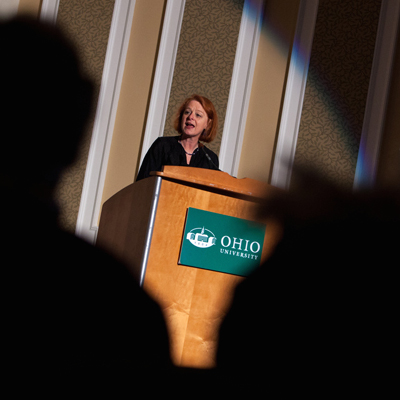
Koening attributes some of the social inequalities to the party atmosphere among students. To fight against the still existing cultural prejudices, Madison encourages women to support one another in and out of the classroom. Still, Ohio University continues to move toward equal rights. One of the university’s most recent accomplishments includes the election of Jenny Hall-Jones as Associate Vice President for Student Affairs and Dean of Students.
“The way that she has experienced life as a woman, on a college campus I think is different than the way that many of the male board of trustees members have experienced it,” Koening says. “And so the bigger variety of perspectives we can bring the better we can accommodate all students.”
The push for continued equality and acceptance needs to be taught at early ages with education continuing through adulthood. Carter children today learn more than even current college students, including a greater acceptance of LGBTQ individuals and increased understanding of gender roles and identities. The continuing education gives hope to closing the gap between genders in the future.
“I think it’s something that we want now, but it’s going to be very hard to get now,” Carter says.
Carter says gender equality needs to focus on equal rights for all genders. Men face stigmas too, including not being as good with children or making good teachers. Instead, men learn to be tough, strong and rarely show emotion.
“If women want true equality, then they need to be willing to give up some of these stigmas that they’re placing on men as well,” Carter said. “If I don’t want to be held to Barbie standards, men should not have to be held to G.I. Joe standards.”
Arnold says if a new wave crashes, men need to play a role in striving for gender equality and sees a new wave gaining more momentum every day.
“I think it is my role as a male-identified dude to support female-identified people,” Arnold says. “Men can support women, but ultimately, it’s women’s task to emancipate themselves. If we do a little better today, maybe we’ll do a little better tomorrow.”
Originally posted in Backdrop Magazine.
 Jacob Betzner