

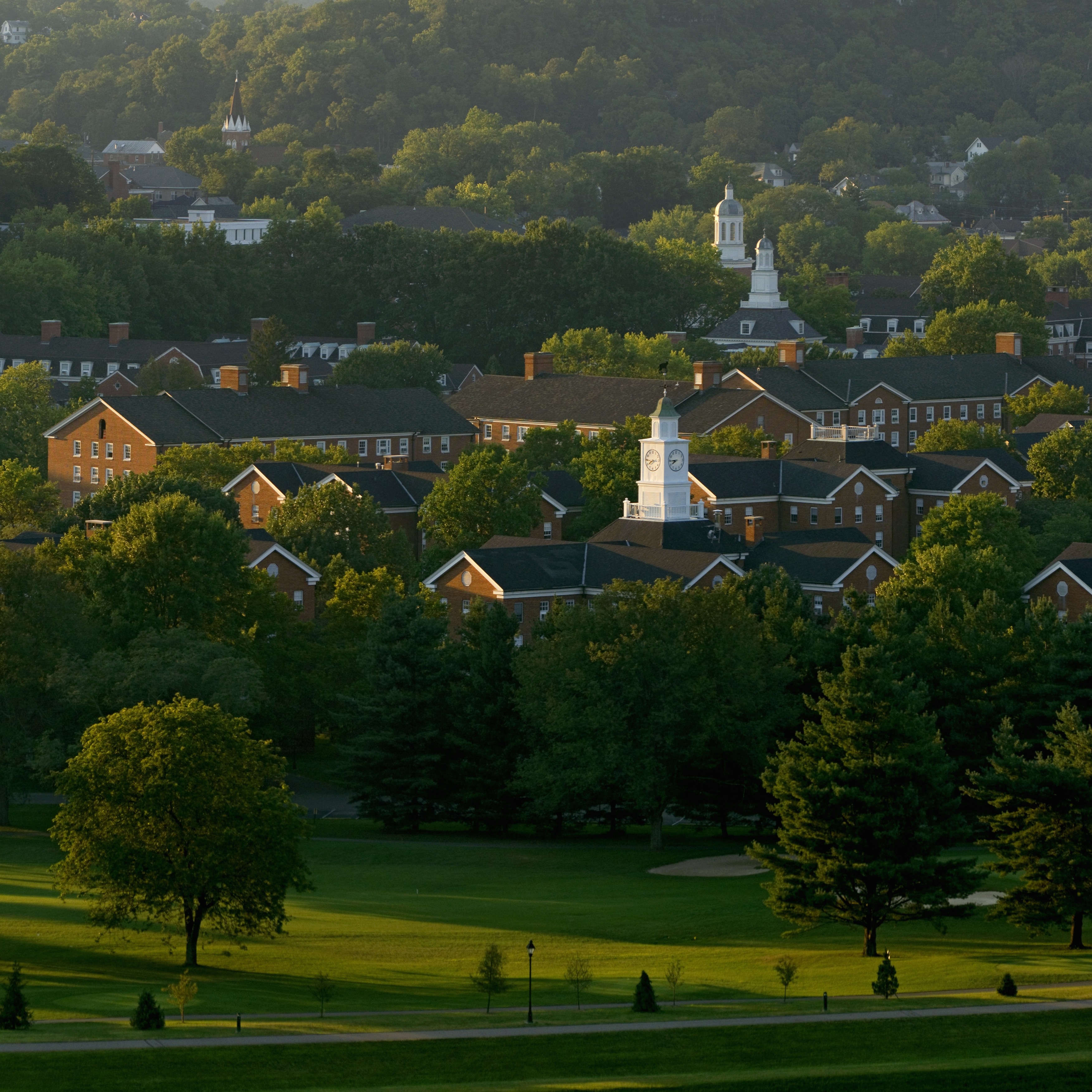
Fenced in and well hidden from the thousands of students who pass by the construction zone on the site of the former Wolfe Street Apartments everyday, the biggest and most expensive residential housing project in the history of Ohio University starts to take shape. Over the next 10 years, the university plans to construct new buildings, add to the total number of beds available on campus, update buildings and create a new area for students to socialize, relax and live the college experience. Cranes and other heavy equipment peek over the temporary fencing to keep curious or, ahem, lush students from entering the site. University-sponsored signs line the area to help the site appear as less of a construction zone and more of a giant surprise.
The next phase of the project involves demolishing residence halls in the area known to students as “Dirty South,” a staple at the university since the late 1960s, and building new, modernized dormitories.
“This is the biggest housing project we’ve taken on since the ‘New South (in the 1960s),’ which is kind of ironic, but that’s what’s going on. That was the largest project in recent times,” says Peter Trentacoste, Director of Residential Housing.
Residence halls behind the “Front Four” buildings on South Green, Pickering, Brown, Mackinnon and Crawford Halls, serve almost solely as a place to sleep. The university constructed the buildings after student population rose significantly during the 1969 Draft Lottery and before and after the Vietnam War, which lasted between 1955 and 1975. Thousands of Vietnam veterans chose to attend OU after receiving a G.I. Bill. Administrators built the residence halls to last only a few decades in the Hocking River floodplain. The location of the flood plain forced the buildings to be raised onto stilts and a series of catwalks constructed to allow students to go in and out of the buildings, especially in the likely event of a flood.
Vice President of Student Affairs Ryan Lombardi says in recent years, the cost of maintenance and upkeep in the buildings in Dirty South exceeded the cost of building new dormitories in the long run. About three years ago, the OU Board of Trustees started developing a plan to demolish outdated buildings and construct new buildings. The trustees proposed construction plans for new residence halls in “Dirty South,” planning to tear down the old buildings and build suite-style dormitory buildings, budgeting the project at $4.5 million, according to financial statements from the OU financial department. The buildings still house students today, but require thousands of dollars in maintenance to remain open.
“While the building is still certainly safe, and we can continue to operate them, they’re not efficient in any way,” Trentacoste says.
The proposed plan develops over the next 10 years and started with the destruction of the Wolfe Street Apartments across South Green Drive from the Charles J. Ping Recreational Center. The university rented the near half-century-old apartments to graduate students, married couples and singles with children, faculty and staff. McVey Demolition of Cincinnati demolished the apartments and Evans Landscaping also of Cincinnati rebuilt a parking lot on the former site for a combined $531,200.
Lombardi compares building the new dormitories to purchasing a house. The university took out 30-year loans to pay for the projects and developed a financial plan to pay the loans and interest back on time. Lombardi says the university plans to increase on-campus housing rates at 3.5 percent per year, and start at rates comparable to a suite style like Adams or Bromley Halls, which currently cost students $3,314 per semester, or $6,628 per year. With those annual increases, rates go up by nearly $2,300 in 10 years, $4,650 in 20 years and nearly $7,000 per year in 30 years when the loans need to be paid off. However, Lombardi says the university expects the buildings to last 100 years.
Students hope the new residence halls maintain the same type of feel and atmosphere of the current Dirty South but understand the need for the upgrade. Bryan Dziak arrived at OU in August 2010, ready to move in to a double in O’Blenness Hall on South Green. The freshman double majoring in business and marketing information systems remembered touring the campus only a few months earlier, visiting a sizeable, renovated room in a building on East Green. Dziak looked around the tiny, worn dorm room built almost 45 years earlier.
“I knew it wasn’t going to be super flashy,” Dziak says. “That’s kind of what I had in mind. I wasn’t expecting some state-of-the-art room or anything like that.”
Trentacoste says the university plans to build state-of-the-art buildings with amenities similar to those of Adams Hall plus additional conveniences. Dziak says not constantly worrying about housing charging students for a scratch in the wall at the end of the year or some wear-and-tear on the provided dresser in Dirty South dorms lessened the burden on busy college students.
“(The new dorms) are still going to get destroyed, so I don’t think that’s worth a tuition increase when they can build ones that are sufficient for a price that’s not going to raise tuition,” Dziak says.
However, fellow former Dirty South resident Jaime Cosimati, a senior studying Sociology and Criminology who lived in Hoover Hall as a freshman moved into a remodeled dorm in Bromley Hall as a sophomore and saw the cost of housing rise.
“When I lived in Bromley, I know I paid a little bit more or extra than others, and I didn’t mind doing that,” Cosimati says.
The university plans to complete a 900-bed dormitory building in the next two years. The next phases include building two large dormitory buildings with around 700 rooms behind the current “Front Four” buildings on South Green and another new dormitory building behind Adams Hall, currently the newest dormitory building on campus at only a decade old. Behind the new buildings covering part of the former “Dirty South,” the university plans to build intramural and varsity sports practice fields and expand the popular South Beach, in a segment of the project Trentacoste refers to as a “Green Sweep.”
“What I’m most excited to see come to fruition is this real green space, vibrant with student activity where community members can come and walk and be part of campus, and while they’re on campus also walk and appreciate the beauty of the nature that surrounds us,” Trentacoste says.
The new and improved South Beach trades parking lots and little-used roads for a large grassy area between the dormitories and Morton Hall to give students a place to socialize, engage in physical activity and simply relax.
The Columbus branch of URS Corporation agreed to build the new residence halls at a cost of $3,633,472.80 and EMH&T also of Columbus agreed to build additional infrastructure for $108,576, for a total of $4,273,248.80, or $226,751.20 under budget.
The building on the site of the former Wolfe Street Apartments includes suite-style rooms similar to Adams Hall, with slight modifications, especially to the bathroom areas. Lombardi says the new bathrooms feature a private toilet and semi-private shower in addition to two sinks in the bathroom instead of in the actual room. The new design scheme comes from student feedback and encourages additional student input as construction begins on the new buildings in the next three years.
Dziak and Cosimati both say the mod style encouraged students to interact and forge friendships.
“You kind of have your own, little personal family, and you became close with the people you lived with,” Cosimati says.
Cosimati says she toured a dorm on East Green while touring as a high school student. Though much different than the “mod” style of the dorm rooms in the Dirty South, she researched the assigned room and knew what to expect.
“I was actually pretty excited about it just because I knew it was going to be a lot easier to become close to the people I lived with,” Cosimati says.
Dziak says living in the close quarters of the “mod” style dorms helped establish strong friendships.
“Everybody back there just seemed to have similar personalities, and you know, people are there for different majors, different walks, but nonetheless, everybody, we all seemed to hit it off really well.”
University officials hope the new buildings and nicer rooms entice a greater number of students to choose to attend OU. Lombardi says he and other university representatives toured campuses throughout the region and observed new dormitories recently built at other universities. Nearly two-thirds of all campus housing will be on South Green at the end of the project.
Dziak says while updated housing helps bring in students, the appeal alone of OU keeps students choosing to study in Athens every year.
“If it looks nicer, people are going to be more attracted to it. That’s just how people are,” Dziak says.
In addition to residence halls, the plan calls for a Central Learning Commons. The commons features classrooms, meeting space for student organizations and flexible office space. Trentacoste says the flexible office space means tutors, counselors or resident coordinators all use the same office during different hours to add accessibility and convenience for students. Additionally, the new residence halls include more common areas for studying and socializing, including a proposed two-story lounge area for studying. Years of planning and research went into the new buildings before the first phase started last spring semester.
“Instead of building the building, and ‘Oh, well now where do we fit the students in?’ We thought, ‘How would we cluster together students in the first place?’” Trentacoste says. “So, the communities were built first, and then we filled building structures around them.”
Trentacoste, Lombardi and all the other university officials closely involved with the project hope the buildings become a place of reference for future Bobcats for generations. Students hope the South Green, especially the Dirty South keeps the special something that brings students together, forges lifelong friendships and becomes a memorable part of a student’s early years on campus. The area already holds a special place in the hearts of many Bobcats.
“I think South Green, though, kind of applies to a large demographic of students that go to OU, whether they’re the partiers or the more laid-back, who want to hang around, who don’t spend all their time studying because they can still get by,” Dziak says. “South Green is more for, like, everybody else. Kids from all jacks-of-trade. Honestly, that was one of the best parts of being on South Green. Everybody kind of knew what they were getting into, and that was why they were all living there.”
Originally posted in Backdrop Magazine
 Jacob Betzner