
The buzzer sounded. The Chinese Taipei basketball team defeated China 82 to 79 to win the gold medal in the East Asian Games. The team wears Chinese Taipei on the front of uniforms instead of Taiwan.
The victorious team watched the flag of Chinese Taipei rise to the rafters of the stadium–different from the bright red national flag of Taiwan bearing the blue sky and white sun symbol in the upper left corner. In the background, the National Flag Anthem played over loudspeakers instead of the National Anthem of the Republic of Taiwan.
The same flag ascended to the tops of complexes in Athens, Greece in 2004 when Mu-yen Chu and Shih-hsin Chen won Olympic gold medals in the flyweight division of taekwondo, the first and only Olympic gold medals in the history of Taiwan.
Pei-shan Tang, Deputy General Secretary of the Chinese Taipei Waterski and Wakeboard Association competed for the Chinese Taipei wakeboarding team and said the name Chinese Taipei further blurs the lines between Taiwan and Mainland China.
“It’s always confusing that people don’t understand why we use Chinese Taipei instead of Taiwan,” she said. “Taiwan isn’t well-known enough, and it’s even harder to get [the world] to know more about Chinese Taipei.”
Tang studied at the Chinese Taipei Olympic Academy and learned the history behind Chinese Taipei instead of Taiwan.
“I understand it, so I will still be proud of wearing whatever representing my country,” she said.
In 1981, the Chinese Taipei Olympic Committee and International Olympic Committee signed an agreement, which established the protocol Taiwan using the flag and anthem of Chinese Taipei in international events.
“Taiwan is obligated to follow this agreement in order to protect its equal status and rights for participation in international sporting events,” wrote the Sports Administration of the Ministry of Education in an official statement.
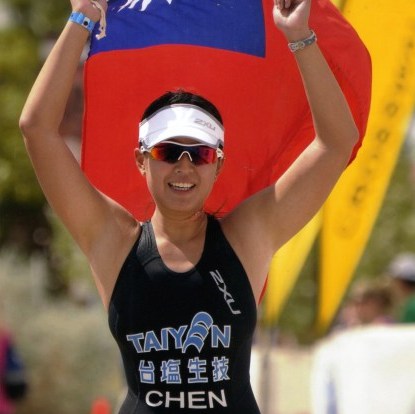
Pei-wen Chen, a former triathlete with the national team and with Soochow University in Taipei, studies political science focusing on relations between China and Taiwan. Chen competed in races throughout the world for Chinese Taipei.
“We couldn’t call us Taiwan, so we call us Chinese Taipei, and when we race, also, our flag cannot show on our clothes,” Chen said. “Actually, I have been to China for a race, and when they check our tracksuits, we couldn’t show our flag.”
Mainland China forbids athletes from Taiwan from stitching Taiwan on team uniforms, flying the national flag of Taiwan and playing the national anthem of Taiwan at international competitions. Mainland China claims Taiwan as a territory but allows the island to compete in international events as “Chinese Taipei.”
“I really believe that Taiwan is a country. We have an army, residents, a government and our land,” Chen said.
The issue arose after the People’s Republic of China formed under dictator Mao Zedong in 1949, ousting the Kuomintang political party to the island of Taiwan, forming the Republic of China. The Republic of China retained a seat with the United Nations until 1971.
Taiwan used some form of Taiwan or the Republic of China until the 1976 Summer Olympics in Montréal. Canada, not recognizing Taiwan as a legitimate country, refused to allow athletes from the island to represent Taiwan or the Republic of China. Taiwan boycotted the 1980 Summer Olympics in Moscow after the decision, but agreed to participate as Chinese Taipei by the 1984 Summer Olympics in Sarajevo.
Tian-ying Fan, president of the Chinese Taipei Touch Association said fans represent the national teams as Taiwan at international competitions.
“Supporters will bring Taiwan National Flag and sing the national anthem instead of the Chinese Taipei flag,” Fan said. “It is an issue, which goes back a few decades, but people will support their team and athletes regardless.”
Fan said athletes feel a sense of national pride regardless of the name on the uniform.
“In the long run, sending teams to represent their country is what keeps people motivated,” Fan said.
Taiwan complies with China for fear of military action if thought of a move for independence and because of a heavy reliance on trade with Mainland China.
“If the government want to have business with China, then they have to follow the rules, and they don’t want to fight China, because China is a powerful country now,” Chen said.
Jin-shu Hsu, a former gymnast who competed for the National Taiwan Normal University, said China interferes when athletes representing Chinese Taipei try to wave the national flag of the Republic of China at international sporting events like the Olympics. Some Taiwanese feel strongly about the name.
“Sure, we are independent,” Hsu said. “It’s not a big issue for me, but other people are angry about this.”
Chen said the inability to represent Taiwan angers most national athletes, but few understand the reasoning behind Chinese Taipei.
“We have problem between China and Taiwan,” Chen said. “We know there are problems, but we couldn’t understand why.”
Willy Chuang, currently studying for the Taiwan Civil Service Exam played low-level college baseball. He said sports recently gaining more popularity in Taiwan.
When the most popular national teams, baseball, basketball and taekwondo hit televisions, Taiwanese turn it into a celebration. Citizens sing songs, cheer and set off fireworks after a big victory.
“No matter what political idea people have, we always feel frustrated that our national team cannot fly our national flag,” he said.
Yan-wen Chen, a software engineer in Taipei and a huge fan of the Chinese Taipei soccer and baseball teams said remembers Taipei erupting with every run when Chinese Taipei took on Japan in the World Baseball Classic in May.
“Everybody just stands on the street and if we score, everybody cheers. It’s very amazing,” he said. “I think most of the people don’t very care about names, they just cheer for the win.”
Some athletes want to represent Taiwan instead of Chinese Taipei. Tang hopes one day the IOC reconsiders and allows Taiwanese athletes to use the name, flag and anthem of Taiwan. Chen tried to show the Taiwan flag at races internationally and claimed to represent Taiwan, but lacked support from the Taiwanese government.
“I always bring my flag, and when I race, I always call myself Taiwan,” Chen said. “We are not Chinese Taipei, we are Taiwan.”
 Jacob Betzner