

Raven King tensed at the plate, waiting for the next pitch. The innate ability to hit a softball, the instinct to adjust timing, bat speed and velocity, existed in her brain the first time she picked up a bat. Now, the junior studying engineering at Ohio University, sees the game in formulas she calculates in her head. She grips the bat tighter, calculates the ball’s velocity, adjusts her bat speed, and times it perfectly: home run.
Raven attracted the attention of OU Softball Head Coach, Jodi Hermanek, after a dominant performance in a tournament game in Las Vegas in 2009. Hermanek went to the game to scout a player on the other team, but saw so much potential in Raven that she approached the Utah native.
Raven wanted to get out of Utah, ideally somewhere along the West Coast, near Los Angeles, her birthplace, but she never really considered Ohio or the Midwest.
“I thought, ‘Ohio? What’s in Ohio?’” Raven asks. “My dad kept pushing me to check it out, so I set up a visit. I loved the campus. It was beautiful. I liked the small college-town atmosphere and fell in love.”
She knew she wanted to study engineering in college after hearing of the high demand for engineers across the nation and was aware of the financial security offered by a career in engineering.
Utah State told the high school senior to choose between playing softball and studying engineering, explaining that the young student-athlete wouldn’t be able to balance the demanding schedules of both. Raven considered a community college, but decided more than four years of school sounded unappealing. OU ultimately offered her the best of both worlds.
Raven represents a small percentage of student-athletes at OU who take on a major most students consider more challenging. A statistical analysis of approximately 198 student-athletes in major sports at OU, including football, basketball, soccer, volleyball, baseball and softball, shows only 4.6 percent of student-athletes belong to the Russ College of Engineering and Technology.
Many student-athletes incorporate sports or physical activities into their studies. The College of Business has the highest number of student-athletes, with 21.5 percent, nearly half majoring in Sport Management, hoping to remain involved in athletics professionally.
Another 16 percent of student-athletes are in the College of Health Sciences and Professions, many of whom concentrate in health service administration or exercise physiology. The minority of student-athletes major in soft sciences or other areas typically considered less demanding by college students.
Declaring a demanding major keeps Raven strained for time. Every weekday during softball season, she wakes up at 6 a.m. and goes to Peden Stadium for weight training, fits in classes between 8 a.m. and 1 p.m., and practices with the team until 5 p.m., leaving time for one more evening class or a night of studying. The second team All-MAC infielder usually makes it to bed around 1 a.m.
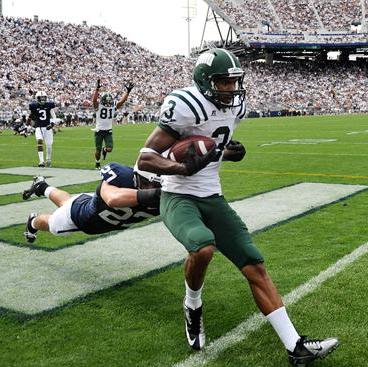
To help with busy schedules, the OU Athletic Department offers plenty of resources to student-athletes. Jordan Thompson, a redshirt senior tight end and two-time captain of the OU football team, says the extra help is extremely beneficial, and raved about a professional networking website developed exclusively for student-athletes. The website, CareerAthletes. com, similar to LinkedIn.com, connects student-athletes across the country to current and former student-athletes in a professional setting.
“I guess student-athletes like to hire student-athletes,” Jordan says, who also studies engineering. “We have the same motivation, the same drive and can relate to one another based on past experiences.”
The athletic department also helps student-athletes develop vital career and life skills to supplement the student-athletes’ education in the classroom. Recently, the athletic department brought in a former OU linebacker who spoke to the graduating senior football players. The former Bobcat talked about transitioning values learned on the field into a career.
“Football is going to come to an end. Whether it be at the end of our four years here, or you’re fortunate enough to get a shot at the NFL or CFL, but that’s two or three years maybe, max,” Jordan explains. “To get guys to think ahead, and plan out what they’re doing down the road, I think that’s valuable.”
To make sure every student-athlete stays on track, he or she meets with an academic adviser assigned by his or her respective college, like every OU student. Additionally, student-athletes meet with an academic athletic adviser to ensure they are following NCAA academic rules and regulations.
The NCAA requires each athlete to maintain a minimum GPA to participate in athletics. OU student-athletes near the minimum GPA spend a set number of hours in a mandatory study hall at the athletic department in Peden every week.
“We have so many people watching over us,” Jordan says. “Our coaches, the athletic academic advisers, and our teammates who are counting on us to get it done in the classroom, so we can stay on the field.”
Another group of advisers dedicated to helping the student-athletes are learning specialists such as Hope Howell and Brittany Tyree, both former NCAA student-athletes who help student-athletes off the field. They work under Associate Athletic Director Randee Duffy, who keeps track of NCAA eligibility and student-athlete success.
Additionally, tutors, offered free of charge to student-athletes, take on the responsibility of helping many student-athletes succeed in the classroom. Raven says the tutors help with some classes, but she started figuring things out on her own after her freshman year.
With student-athletes coming from all different educational backgrounds and different levels of proficiency in time management and technology, the learning specialist attempts to quickly acclimate the student-athletes.
“We mostly help with time management, especially early in the semester,” Tyree says, a former runner for the OU Track and Field team. “We help them realize they have to start to do things on their own.”
Duffy and the other learning specialists help student-athletes stay ahead in the classroom by helping them plan accordingly. The NCAA requires student-athletes to complete a minimum number of credit hours and coursework within a major.
Combined with OU’s requirements, scheduling around practices and games demands a lot of planning.
The athletic academic support team never encourages student-athletes to take less demanding courses, rather the support team suggests student-athletes take a more difficult or time consuming class during his or her offseason.
“Our purpose is mostly to accommodate for travel,” Duffy explains. “If a class has a strict attendance policy, we usually have the athlete take that when [he or she] won’t be traveling, but as for more difficult classes, if they’re strong in [a certain subject] they can take it whenever.”
The NCAA Eligibility and Student-Athlete Success Center also encourage a post-collegiate focus: helping develop life skills and hosting résumé and portfolio workshops, resources to help prepare student-athletes for life after the final snap, shot or swing.
So far, the athletic department has been successful; OU’s graduation rates for student-athletes were well above national averages last year, including 74 percent of football players compared to a national average of 63 percent, and 100 percent of softball players, compared to a national average of 74 percent, according to data from the NCAA.
Raven sees a bright future after softball. She has learned teamwork, drive, determination and the right amount of competitiveness on the softball diamond, time management and productivity from the athletic department, and other practical skills from OU. With all this, she hopes to find success as a transportation civil engineer.
“In almost all cases engineers work together as teams,” Raven says. “By be-ing in a team environment already, especially one that is organized by a university, I have shown that I can work with others, manage my time and be efficient, and think clearly and work under pressure to achieve a common goal.”
Originally posted in Backdrop Magazine
 Jacob Betzner